Inventory and Inventory Management: Types & Methods
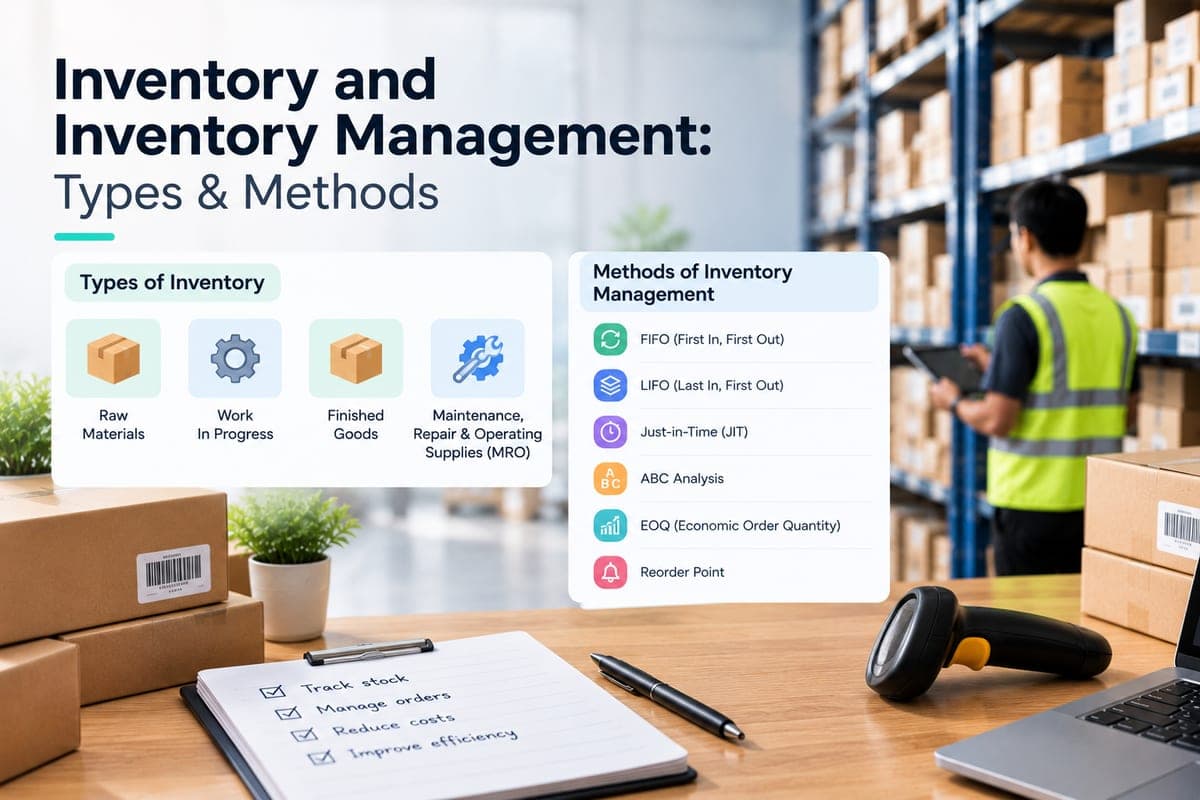
Inventory is the raw materials, work-in-progress, and finished goods a business holds to meet demand. Inventory management is the discipline of tracking, controlling, and optimising that inventory — deciding how much to hold, where to hold it, and when to reorder — so a business has enough stock to meet demand without tying up excess cash in goods that sit unsold.
Table of Contents
- What Is Inventory?
- What Is Inventory Management?
- Why Inventory Management Matters
- Inventory Management vs. Inventory Control
- Inventory Management Methods
- Key Inventory Management Metrics
- Inventory Management Systems and Software
- How Nventory Supports Inventory Management
- Frequently Asked Questions
What Is Inventory?
Inventory falls into a few distinct categories, and knowing which type you're managing changes how you should manage it:
- Raw materials — inputs not yet used in production
- Work-in-progress (WIP) — partially completed goods still moving through production
- Finished goods — completed products ready for sale
- MRO inventory — maintenance, repair, and operating supplies that support production but aren't sold directly
- Safety stock — buffer inventory held specifically to protect against demand spikes or supply delays
A manufacturer typically manages all five categories at once; an ecommerce retailer mostly deals with finished goods and safety stock. That distinction matters because the tools and methods that work well for one don't necessarily transfer to the other.
What Is Inventory Management?
Inventory management is the end-to-end process of overseeing that inventory — from forecasting demand and ordering stock, to tracking it across locations, to fulfilling orders and replenishing what sells.
Done well, it answers three questions continuously: how much stock do we need, where should it sit, and when do we reorder — all while minimising the capital tied up in goods that aren't moving.
Why Inventory Management Matters
The financial stakes are larger than most businesses realise. IHL Group's Inventory Distortion Study puts the global cost of inventory distortion — the combined impact of overstocks and stockouts — at roughly $1.7 trillion a year, around 6% of global retail sales, with the larger share of that coming from out-of-stocks rather than overstocks. That cost shows up in two directions:
- Stockouts don't just cost the one lost sale. They push customers toward competitors and can hurt a retailer's marketplace search ranking and shelf placement.
- Overstocking ties up capital in goods that aren't selling, with carrying costs — storage, insurance, depreciation, obsolescence — commonly cited at 20 to 30% of inventory value per year.
Both problems trace back to the same root cause more often than not: poor visibility into what's actually in stock, where it is, and how fast it's moving. A retailer running each location as its own silo can be simultaneously out of stock in one store and overstocked on the same SKU in another, and never see it — which is why unified, cross-location visibility tends to reduce customer-facing stockouts even before any change to forecasting or purchasing.
Inventory Management vs. Inventory Control
These two terms get used interchangeably, but they describe different scopes of work:
| Inventory Management | Inventory Control | |
|---|---|---|
| Scope | Strategic — demand forecasting, purchasing decisions, supplier relationships, multi-location strategy | Tactical — day-to-day tracking of stock already in the warehouse |
| Core question | "How much should we have, and where?" | "Where exactly is what we already have, right now?" |
| Typical owner | Operations or supply chain manager | Warehouse or inventory clerk |
Inventory control is a subset of inventory management. You can't manage inventory well without controlling it accurately first, but good control alone doesn't guarantee good purchasing and forecasting decisions above it.
Inventory Management Methods
A handful of established methods and frameworks handle most inventory management decisions:
- FIFO (First In, First Out) — the oldest stock sells first; standard for perishables and anything with a shelf life.
- LIFO (Last In, First Out) — newest stock sells first; used mainly for accounting and tax purposes in certain jurisdictions, less common operationally.
- JIT (Just-in-Time) — inventory arrives right before it's needed, minimising holding costs but requiring highly reliable suppliers.
- EOQ (Economic Order Quantity) — a formula-based approach to finding the order quantity that minimises total ordering and holding costs.
- ABC analysis — classifying inventory by value and turnover, where A is high-value and high-priority and C is low-value and low-priority, to focus attention where it matters most.
- Perpetual vs. periodic tracking — perpetual systems update stock counts continuously with every transaction; periodic systems rely on scheduled physical counts. Most modern software defaults to perpetual because it eliminates the blind spots periodic counting creates between counts.
No single method is universally "correct." Most businesses combine a couple of these — commonly ABC analysis with perpetual tracking — rather than picking just one.
Key Inventory Management Metrics
A few metrics come up repeatedly when measuring whether inventory management is actually working:
- Inventory turnover ratio — how many times inventory sells and is replaced over a period. See our full breakdown of the inventory turnover formula and industry benchmarks for the calculation and worked examples.
- Days Inventory Outstanding (DIO) — the average number of days stock sits before selling.
- Stockout rate — the percentage of demand that couldn't be met because an item was unavailable.
- Carrying cost — the total cost of holding inventory, typically expressed as a percentage of inventory value per year.
- Order accuracy — the percentage of orders fulfilled correctly, without picking or shipping errors.
Tracking these together, rather than any single one in isolation, is what actually surfaces problems early. A healthy turnover ratio can still hide a high stockout rate on your best-selling SKUs if you're not watching both.
Inventory Management Systems and Software
Most businesses beyond a spreadsheet-and-clipboard stage rely on inventory management software to handle the tracking and calculations above automatically.
These range from lightweight, single-location tools to full warehouse management systems built for complex floor operations, with cloud-based platforms now the default deployment model for most growing businesses rather than on-premise installs.
The right choice depends heavily on whether you're managing one warehouse with complex floor logistics, or inventory spread across multiple channels and fulfillment locations. Those are genuinely different buying decisions, not just different price points of the same tool. If your operation is specifically ecommerce, our ecommerce inventory management guide covers the channel-level strategies and KPIs that matter in that context.
How Nventory Supports Inventory Management
Nventory is built specifically for the second scenario above: businesses managing inventory across multiple sales channels and fulfillment locations — FBA, 3PL, and owned warehouses — rather than a single facility with complex floor operations. That covers the core inventory management job in a few concrete ways:
- Real-time inventory sync in under 5 seconds across 40+ integrations spanning 23 commerce channels, so stock counts reflect what's actually happened rather than a stale snapshot
- Multi-warehouse support with automatic order routing, giving the unified cross-location visibility that keeps one location's shortage from hiding behind another's surplus. Location limits scale by plan, with unlimited locations on the top tier.
- 99.9%+ inventory accuracy, which is the foundation every metric in the section above depends on being trustworthy
- A free plan, so you can connect your catalog and see it working before paying anything
Closing
Good inventory management starts with accurate, real-time visibility — every method and metric above only works if the underlying data is trustworthy. Keeping inventory synced across every channel and warehouse you use is what makes the numbers behind your forecasting and purchasing decisions reflect reality.
Frequently Asked Questions
Inventory is the physical stock a business holds, including raw materials, work-in-progress, and finished goods. Inventory management is the ongoing process of tracking, controlling, and optimising that stock to meet demand without tying up excess capital in goods that are not moving.
The main categories are raw materials, work-in-progress (WIP), finished goods, MRO supplies covering maintenance, repair and operating needs, and safety stock held as a buffer against demand spikes or supply delays. A manufacturer typically manages all five at once, while an ecommerce retailer mostly deals with finished goods and safety stock.
Inventory management is the strategic side: forecasting demand, deciding what and how much to purchase, and where to hold it. Inventory control is the tactical, day-to-day tracking of stock already in the warehouse. Control is a subset of management, and accurate control is a precondition for good management rather than a substitute for it.
FIFO, LIFO, Just-in-Time (JIT), Economic Order Quantity (EOQ), and ABC analysis are the most widely used frameworks, usually combined with perpetual rather than periodic stock tracking. No single method is universally correct, and most businesses combine a couple of them rather than picking just one.
Poor inventory management costs businesses in two directions: stockouts lose the sale and push customers toward competitors, while overstocking ties up capital in goods that are not selling and carries holding costs commonly cited at 20 to 30% of inventory value per year. IHL Group puts the global cost of inventory distortion, meaning the combined impact of both, at roughly $1.7 trillion a year.
Most businesses beyond a very small, single-location operation benefit from software over spreadsheets, since manual tracking is inherently reactive and cannot provide real-time visibility or automated alerts. The right type depends on whether you are managing one complex facility, where a warehouse management system fits, or inventory spread across multiple channels and locations, where an order and inventory platform is the better layer.
Related Articles
View all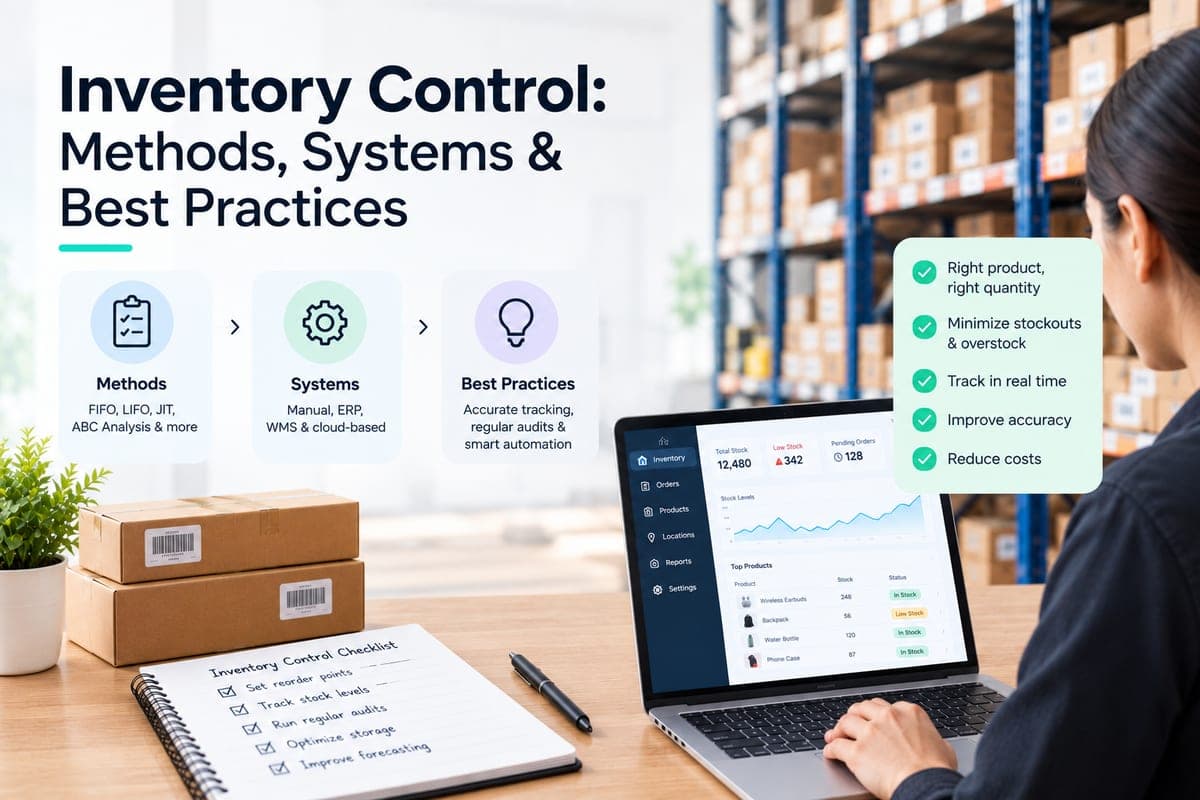
Inventory Control: Methods, Systems & Best Practices
What inventory control is, how it differs from inventory management, perpetual vs periodic systems, and the methods that keep stock counts accurate.
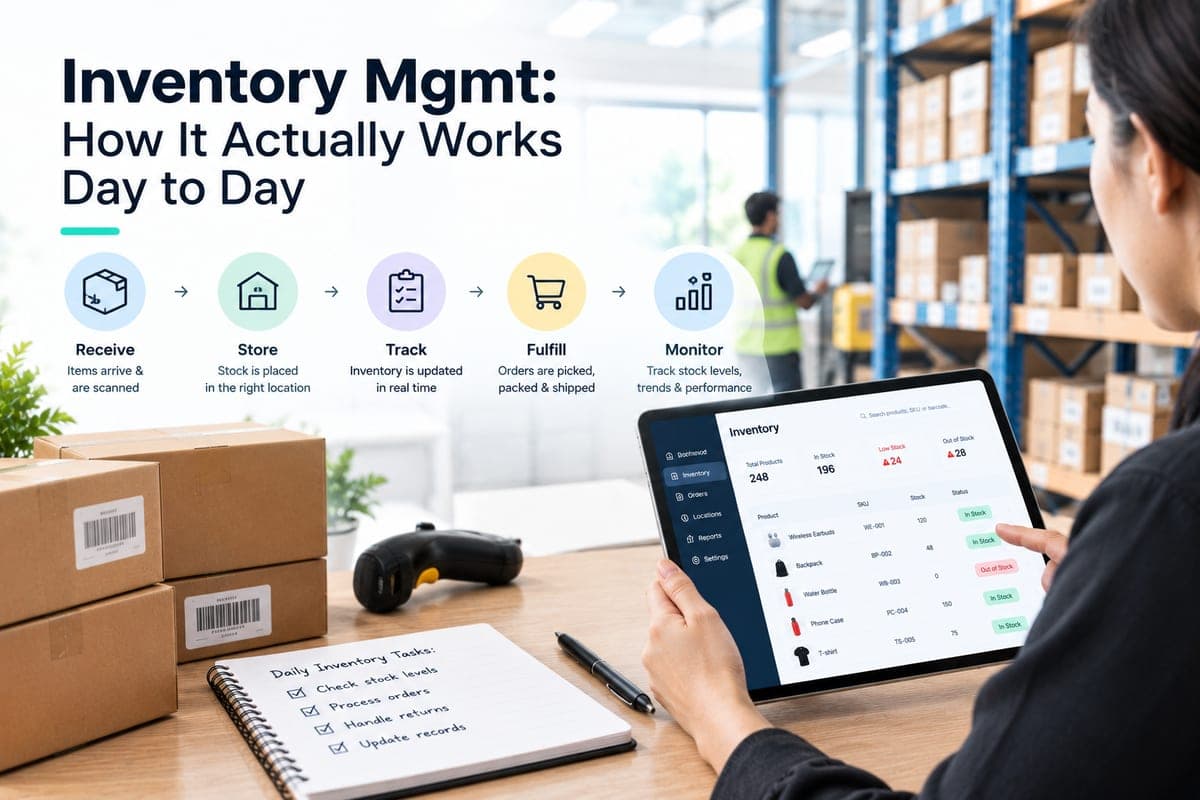
Inventory Mgmt: How It Actually Works Day to Day
The six-step inventory mgmt cycle, which role owns each part of it, the mistakes that quietly cost the most, and how to tell whether the process is working.