What Is MCP? The Protocol That Makes AI Actually Useful for Ecommerce
TL;DR
- MCP stands for Model Context Protocol — an open standard introduced by Anthropic in November 2024.
- It lets AI assistants (Claude, ChatGPT, Gemini) connect to live business data in real time, not just training data.
- Without MCP, every answer your AI gives about your operations is a confident guess based on stale information.
- With MCP, your AI can query real orders, live inventory levels, and customer records the moment you ask.
- MCP is not a niche developer tool — OpenAI, Microsoft, and Google DeepMind all adopted it in 2025. It is the emerging universal standard for AI-to-data connectivity.
Table of Contents
- The Problem Nobody Talks About With AI Assistants
- What Is MCP (Model Context Protocol)?
- How MCP Works: The Architecture in Plain English
- MCP vs API: Why This Is Not Just Another Integration Standard
- What MCP Means for Ecommerce Operators
- MCP Security: What You Need to Know Before Connecting Your Data
- Who Is Adopting MCP? The Industry Landscape in 2026
- MCP vs RAG: Two Different Problems
- How to Get Started With MCP for Your Ecommerce Store
- Useful Sources
- Frequently Asked Questions
The Problem Nobody Talks About With AI Assistants
AI assistants are impressive until you ask them something that actually matters to your business.
Try it. Open Claude or ChatGPT and ask: "What is my current inventory level for SKU-4821 on Amazon?" The model will not answer. Not because it is dumb. Not because the question is too complex. Because the AI is completely disconnected from your business. It has no idea what SKU-4821 is, what your Amazon account looks like, or what sold in the last 24 hours. It is operating in an information vacuum and it knows it.
This is the core problem that the AI industry spent 2023 and 2024 quietly ignoring. The narrative around AI assistants focused relentlessly on capability — reasoning, coding, writing, summarization. What it glossed over was context. An AI model is trained on a static snapshot of the world. Its knowledge has a cutoff date. Its understanding of your business is exactly zero unless you paste information into the chat window manually. Every answer it gives about your operations is, at best, a well-reasoned guess dressed up as confidence.
For casual tasks, this is fine. For running a multichannel ecommerce operation, it is useless. You cannot ask an AI to flag orders stuck in pending for 48 hours if the AI cannot see your order management system. You cannot ask it to identify which SKUs are approaching reorder point if it has no access to your warehouse data. You cannot ask it to compare your Shopify performance against Amazon this week if it has never touched either platform.
The AI tools that exist today are genuinely powerful reasoning engines sitting behind a wall with no door. They can think. They just cannot see. The Model Context Protocol is the door.
What Is MCP (Model Context Protocol)?
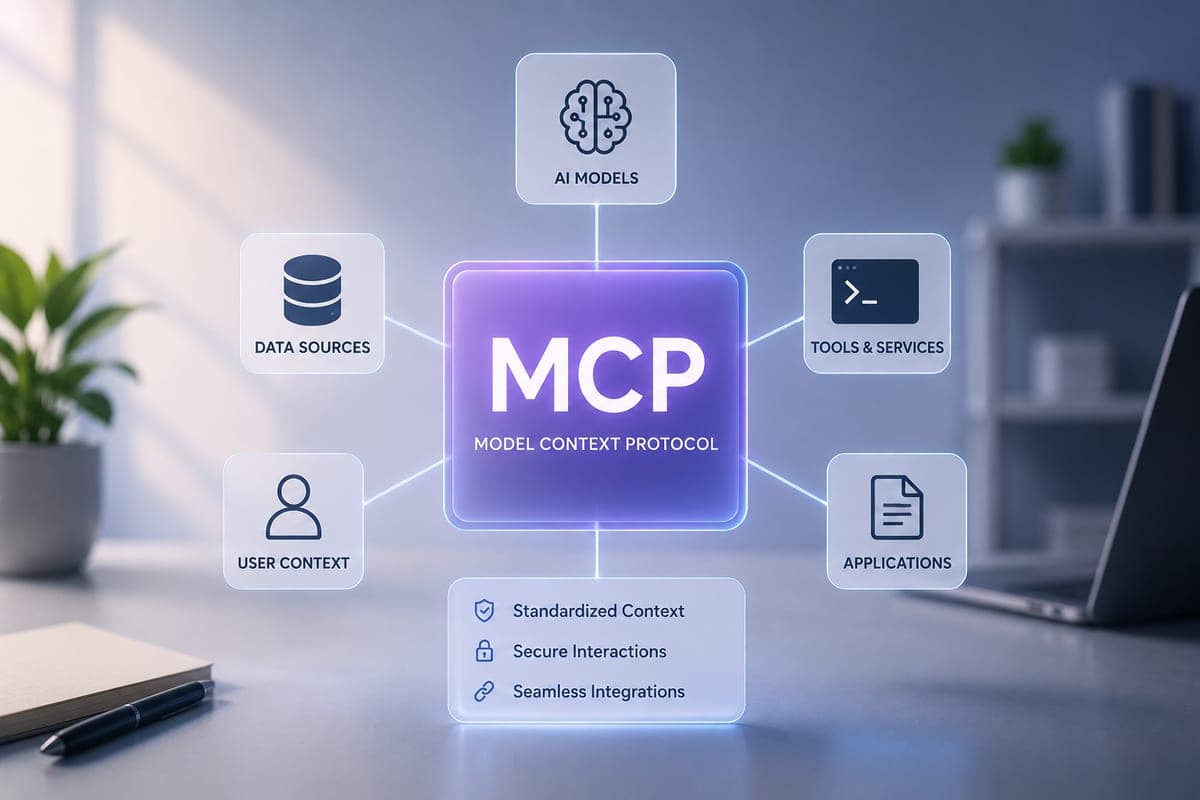
What is MCP in AI terms? It is the open standard that gives AI assistants a structured, secure way to connect to external data systems and act on live information in real time.
MCP — Model Context Protocol — was introduced by Anthropic on November 25, 2024, as an open-source specification. The goal was straightforward: create a universal connector between AI assistants and the data sources, tools, and systems those assistants need to be genuinely useful. Not a proprietary integration. Not a vendor-specific plugin. A protocol — like HTTP for the web or SMTP for email — that any AI system and any data source can implement once and use everywhere.
To understand why this matters, consider the integration problem that existed before MCP. If you had three AI tools and five data sources, you needed fifteen separate custom integrations — one for every AI-to-data pairing. Add a sixth data source and you need three more integrations. Add a fourth AI tool and you need five more. The complexity scales as N×M, where N is the number of AI tools and M is the number of data sources. In practice, this meant most AI tools connected to almost nothing, because the integration cost was prohibitive.
MCP collapses this to N+M. Build one MCP server for your data source, and every MCP-compatible AI can connect to it. Build one MCP client into your AI tool, and it can connect to every MCP-compatible data source. The combinatorial explosion disappears.
The MCP protocol is built on three primitives. Resources are read-only data that an AI can access — your product catalog, your order history, your customer records. Tools are actions with side effects — creating a draft order, updating an inventory level, triggering a reorder. Prompts are reusable templates that package common queries into repeatable, structured requests. Together, these three primitives cover the full range of what an AI assistant needs to interact meaningfully with a live business system.
What is model context protocol at its simplest? It is the answer to the question: how does an AI assistant know what is actually happening in your business right now? Before MCP, it did not. With MCP, it can.
How MCP Works: The Architecture in Plain English
The MCP AI architecture has three components. Understanding them is not optional if you are going to use this protocol seriously.
The Host is the AI application the user interacts with directly — Claude Desktop, the ChatGPT interface, a custom AI tool built on an LLM API. The host is where the conversation happens. It is the front end.
The MCP Client is the protocol handler embedded inside the host. When the AI determines it needs external data to answer a question, the MCP client manages the request — formatting it according to the MCP specification, routing it to the right server, and receiving the structured response. The user never sees the MCP client. It operates invisibly between the AI and the data.
The MCP Server is the bridge between the protocol and your actual data. It sits in front of your data systems — your Shopify store, your order management platform, your warehouse — and translates MCP requests into the native API calls those systems understand. The MCP server is where your business data becomes accessible to AI.
Here is what this looks like in a real ecommerce scenario. You type into Claude: "Show me all unfulfilled orders from Shopify placed in the last 24 hours." Claude's reasoning engine determines it needs live order data to answer this. It passes the request to the MCP client. The MCP client formats the request as a structured MCP tool call and sends it to the MCP server connected to your order management system. The MCP server translates that into a Shopify API query — filtered by fulfillment status and timestamp. Shopify returns a JSON payload of matching orders. The MCP server formats that data as a structured MCP response. The MCP client passes it back to Claude. Claude reads the structured data and responds in natural language: "You have 23 unfulfilled orders from the last 24 hours. The largest by value is order #4821 — $340 from a customer in Austin, placed 18 hours ago."
You (prompt)
    ↓
Claude / Host (AI reasoning layer)
    ↓
MCP Client (protocol handler)
    ↓
MCP Server (bridge to your data)
    ↓
Shopify API / OMS / Warehouse System
    ↓
Structured data response
    ↓
MCP Client → Claude → Natural language answer
The entire round trip takes seconds. The AI does not guess. It reads your actual data and reasons about it.
MCP vs API: Why This Is Not Just Another Integration Standard
This is the question most technically literate readers will ask, and it deserves a direct answer. MCP is not just another API. The distinction is architectural, not cosmetic.
A traditional API is a point-to-point connection between two specific systems. It exposes data in a format designed for that system's developers — typically JSON or XML, structured according to that system's data model. To use a Shopify API in an AI context, you need custom code that calls the API, parses the response, formats it in a way the AI can understand, and handles authentication, errors, and rate limiting. Every API integration is a bespoke engineering project. And when the AI model changes, or the API version changes, the integration needs to be rebuilt.
MCP is a universal layer that sits above individual APIs. The MCP server handles the translation between the AI protocol and the underlying API. The AI never touches the raw API directly. It speaks MCP — a standardized language — and the MCP server handles the rest. Write one MCP server for Shopify, and every MCP-compatible AI can use it without modification.
The deeper difference: APIs expose data. MCP exposes context. An API returns a payload of raw data. An MCP server returns structured, semantically labeled information that an AI model can reason about directly. The API is a pipe. MCP is a translator that speaks both AI and data fluently, simultaneously.
| Dimension | Traditional API | MCP |
|---|---|---|
| Setup complexity | Custom code per AI-data pair | One MCP server, any compatible AI |
| AI compatibility | Manual formatting required | Native — AI reads MCP responses directly |
| Data format | Raw JSON/XML, system-specific | Structured, semantically labeled context |
| Maintenance | Rebuild per API version change | MCP server handles version abstraction |
| Real-time capability | Yes, but requires custom polling logic | Yes, with standardized streaming support |
| Security model | API key or OAuth, per-integration | Optional per spec; OAuth 2.1 with scoped access on protected HTTP servers |
The MCP protocol explained in one sentence: it is the standard that makes AI-to-data connectivity a solved problem rather than a recurring engineering cost.
What MCP Means for Ecommerce Operators
This is where MCP stops being a protocol specification and starts being an operational advantage.
Most ecommerce operators in 2026 are using AI assistants for generic tasks — drafting emails, writing product descriptions, summarizing documents. That is fine. But it is also roughly 10% of what AI could do for your operation if it had access to your actual business data. The remaining 90% requires MCP.
Consider what becomes possible when your AI assistant can see your live systems. "Which SKUs are at reorder point across all my warehouses right now?" Without MCP, you open your inventory dashboard, filter by reorder threshold, export a report, and paste it into the AI. With MCP, you ask the question and get the answer in seconds — the AI queries your live inventory data directly, cross-references your reorder rules, and surfaces exactly the SKUs that need attention. "Show me orders stuck in pending for more than 48 hours on Amazon." Without MCP, this is a manual investigation. With MCP, it is a single natural language query that returns a structured list with order IDs, customer names, and timestamps — ready for action. "What's my best-selling product on Shopify vs Amazon this week?" Cross-channel analytics that previously required pulling two separate reports and reconciling them manually becomes a single question answered in real time. "Flag any customers who ordered twice in 7 days but haven't received a shipping confirmation." This kind of operational intelligence — combining order data, customer data, and fulfillment data — is exactly what MCP enables, and exactly what no AI assistant can do without it.
MCP turns your AI from a generic chatbot into an operational co-pilot that knows your actual business. Not a simulation of your business. Not a summary you pasted in yesterday. Your live business, as it exists right now.
This is the architecture that the nventory.io MCP server is built on — connecting Claude, ChatGPT, and any MCP-compatible AI assistant directly to your ecommerce data: products, orders, inventory levels, customer records, and cross-channel analytics, all queryable through natural language without opening a dashboard.
The model context protocol for ecommerce is not a future concept. It is operational today. The operators who build this capability into their workflow now are the ones who will have a meaningful information advantage over operators still pulling manual reports in 2027.
MCP Security: What You Need to Know Before Connecting Your Data
Connecting an AI assistant to live business data is not a decision to make casually. You are giving a language model access to your orders, your customers, your inventory, and potentially your pricing and supplier relationships. The security model matters.
The first thing to understand is that MCP's authorization spec is narrower than most summaries suggest. Authorization is optional in the specification, and it is defined for HTTP-based transports. A protected remote MCP server should conform to the MCP OAuth 2.1 authorization flow — token-based, not username and password, with scopes limited to specific resources and actions, revocable instantly. But an MCP server running over stdio on your own machine explicitly should not use that flow; it retrieves credentials from the environment instead. So "MCP uses OAuth" is true of protected remote servers and not a blanket property of every MCP connection. Check which transport your server actually uses before assuming a particular auth model is in play.
Scoped access is the most important security concept in MCP. You do not have to give an AI assistant full admin access to your business data. You can configure read-only access for inventory queries, order read access for fulfillment questions, and no access at all to sensitive financial or customer PII data. The principle of least privilege — giving the AI only the access it needs to do the specific tasks you want it to do — is the correct default configuration.
Best practices for MCP security in production: Configure read-only access for any AI assistant that does not need to take actions. Enable audit logging so every query the AI makes to your data is recorded with a timestamp. Require explicit user consent flows before the AI can access new data categories. Enforce TLS in transit — all MCP communication should be encrypted end-to-end. Implement rate limiting on your MCP server to prevent runaway queries from consuming API capacity. Use JSON Schema validation to ensure that data returned by your MCP server is well-formed before it reaches the AI.
Data retention is the point where the protocol stops helping you and you have to read contracts. MCP does not define whether the server, the host application, or the model provider stores what passes through — that is an implementation and policy question, not a protocol guarantee. A well-built MCP server can pass data through without persisting it, but nothing in the specification requires that, and the model provider on the other end is a separate question again: most AI models process data through cloud APIs, which raises real GDPR, CCPA, and PCI-DSS considerations once customer PII is involved. Before you connect anything sensitive, check the retention and processing terms for all three layers — the MCP server, the host, and the model provider — and get a data-processing agreement where you need one. A common practical stance is to let the AI query aggregated or anonymized data and keep PII-heavy operations on direct system integrations that bypass the model entirely.
MCP ecommerce security is not fundamentally different from API security. The same principles apply. What MCP standardizes is capability discovery and message exchange — how an AI finds out what a server can do and how the two talk to each other. It does not standardize the safeguards underneath. Authorization, credential handling, and data retention still vary by transport, by server implementation, by host application, and by model provider, so each deployment has to define and review its own controls. Treat a new MCP connection the way you would treat granting a new integration access to production data: check what it can reach, how it authenticates, and who retains what.
Who Is Adopting MCP? The Industry Landscape in 2026
MCP is not a niche protocol championed by one vendor. The adoption curve from November 2024 to mid-2026 is one of the fastest in recent protocol history.
Anthropic created MCP and open-sourced it immediately. The decision to release it as an open standard rather than a proprietary technology was deliberate — Anthropic understood that a protocol only becomes valuable when it is universal. OpenAI adopted MCP in March 2025, announced by Sam Altman, with support rolling out first in the Agents SDK and then across ChatGPT desktop and the Responses API. That moment — a direct competitor adopting a rival's protocol — signaled that MCP had crossed from "Anthropic initiative" to "industry standard." Microsoft followed with Copilot MCP support. Google DeepMind integrated MCP into its AI tooling. Databricks built MCP into its data intelligence platform. Hundreds of third-party MCP server builders emerged, covering everything from GitHub and Slack to Salesforce and custom enterprise data systems.
By mid-2026, any AI assistant you use in a professional context either supports MCP or is on a roadmap to support it. The question for ecommerce operators is not whether MCP will become the standard — it already is. The question is how quickly you build it into your operational workflow before your competitors do.
The MCP integration ecosystem in 2026 is mature enough that you do not need to build a custom MCP server from scratch. Pre-built MCP servers exist for the major ecommerce platforms, order management systems, and data sources. The barrier to entry is lower than it has ever been.
MCP vs RAG: Two Different Problems
These two technologies are frequently confused, and the confusion leads to bad architectural decisions. They are not competing approaches to the same problem. They solve different problems entirely.
RAG — Retrieval-Augmented Generation — is a technique for improving AI answers by pulling relevant documents from a static knowledge base before generating a response. You have a library of product documentation, support articles, or internal policies. RAG retrieves the most relevant documents for a given query and feeds them to the AI as context. The AI produces a better answer because it has access to your specific documents, not just its training data. RAG is excellent for knowledge retrieval from fixed corpora.
MCP connects AI to live, structured, operational data in real time. It is not about documents. It is about systems. Your inventory levels change by the minute. Your order queue changes by the second. RAG cannot help you here — you cannot index a live database into a static knowledge base and expect it to reflect reality. MCP queries the live system at the moment of the question and returns current data.
RAG = better answers from your documents. MCP = real-time access to your live systems. They are often used together. RAG handles the knowledge layer — policies, product specs, documentation. MCP handles the operational layer — live inventory, current orders, real-time customer data. An AI assistant with both is genuinely powerful. An AI assistant with only one is useful in a narrow set of scenarios.
For ecommerce operators, MCP is almost always the higher-priority capability. Your operational questions are about what is happening right now, not about what your documentation says.
How to Get Started With MCP for Your Ecommerce Store
Getting started with MCP does not require a team of engineers. The protocol is mature, the tooling is accessible, and the setup process for ecommerce operators has been simplified significantly since the initial November 2024 release.
Step one: choose an MCP-compatible AI assistant. Claude (Anthropic), ChatGPT (OpenAI), and Gemini (Google) all support MCP as of 2026. Claude Desktop was the first to ship native MCP support and remains the most mature implementation for local MCP server connections. ChatGPT's MCP support through the Agents SDK and Responses API is the right choice if your team is already in the OpenAI ecosystem.
Step two: find or connect an MCP server for your ecommerce platform. If you are running Shopify, Amazon, or a dedicated order management system, check whether your platform has a native MCP server available. Pre-built MCP servers exist for the major ecommerce platforms and eliminate the need for custom development. For operators running their operations through a unified platform, the MCP server is often built in — you generate credentials and connect, rather than building anything from scratch.
Step three: authenticate and define scoped access. If your MCP server is a protected remote server, the connection to your AI assistant is established through the MCP OAuth 2.1 flow; a local stdio server takes credentials from the environment instead. Define the scope of access carefully — start with read-only access to the data categories you want to query, and expand permissions deliberately as you understand how the AI is using the data. Enable audit logging from day one. Test the connection with a simple query before relying on it for operational decisions.
The payoff is immediate. The first time you ask your AI assistant a question about your live business data and get a real, current answer — not a guess, not a cached summary, but actual data from your actual systems — the value of MCP becomes self-evident.
Useful Sources
- Anthropic: Introducing the Model Context Protocol — the original November 2024 announcement, including the open-source specification and SDK release.
- modelcontextprotocol.io — Official Documentation — the canonical technical reference for the MCP specification, primitives, and implementation guides.
- Google Cloud: What Is Model Context Protocol? — Google's explainer covering MCP architecture, security, and Google Cloud's MCP server support.
- TechCrunch: OpenAI Adopts Anthropic's MCP Standard (March 2025) — reporting on OpenAI's March 2025 adoption of MCP, the moment the protocol crossed from single-vendor initiative to industry standard.
- Databricks: What Is the Model Context Protocol? — technical deep-dive covering the N×M integration problem, MCP architecture, security requirements, and agentic workflows.
Frequently Asked Questions
MCP in AI stands for Model Context Protocol, an open standard that gives AI assistants a structured, secure way to connect to external data systems and retrieve live information. In plain terms, it is the mechanism that allows an AI like Claude or ChatGPT to query your actual business data (orders, inventory, customers) rather than relying on static training data. MCP was introduced by Anthropic in November 2024 and has since been adopted by OpenAI, Microsoft, and Google DeepMind as the de facto standard for AI-to-data connectivity.
MCP stands for Model Context Protocol. "Model" refers to the AI language model. "Context" refers to the live, external data the model needs to answer real operational questions. "Protocol" refers to the standardized communication specification that governs how the model and the data source exchange information. Together, the name describes exactly what the technology does: it gives AI models a standardized way to access the context they need to be genuinely useful.
Anthropic created and open-sourced the Model Context Protocol, announcing it on November 25, 2024. Anthropic released MCP as an open standard from the outset, not a proprietary technology, because a protocol only becomes valuable when it is universally adopted. The decision paid off: within four months of the announcement, OpenAI adopted MCP in March 2025, followed by Microsoft and Google DeepMind. Anthropic subsequently donated the MCP specification to a neutral governance body to further cement its status as an industry-wide standard rather than a single-vendor initiative.
An MCP server is the bridge between an AI assistant and a specific data system. It sits in front of your data (your Shopify store, your order management platform, your inventory database) and translates MCP protocol requests from the AI into the native API calls that data system understands. When you ask Claude how many units of a SKU you have in stock, the MCP server receives that structured query, calls your inventory system's API, retrieves the current stock count, and returns it to the AI as a formatted MCP response. The AI never touches your raw API directly. The MCP server handles all translation, authentication, and error handling.
The core difference is scope and purpose. A traditional API is a point-to-point connection between two specific systems, returning raw data in a system-specific format that requires custom code to interpret. MCP is a universal layer that sits above individual APIs: an AI assistant speaks MCP, and the MCP server translates that into whatever underlying API the data source uses. APIs expose data. MCP exposes context, meaning structured, semantically labeled information that an AI can reason about directly. The practical result is that one MCP server makes your data accessible to every MCP-compatible AI, whereas a traditional API integration must be rebuilt for every new AI tool you adopt.
It can be, but the protocol guarantees less than most summaries imply. Authorization is optional in the MCP specification and is defined for HTTP-based transports: a protected remote MCP server should use the MCP OAuth 2.1 flow, with scoped, instantly revocable tokens, while a server running over stdio explicitly should not use that flow and takes credentials from the environment instead. MCP also does not define whether the server, the host application, or the model provider retains what passes through, so retention is a policy question you check per layer, not a protocol guarantee. Most AI models process data through cloud APIs, which raises GDPR, CCPA, and PCI-DSS considerations once customer PII is involved. Best practices include least-privilege scopes, audit logging of all AI queries, TLS in transit, rate limiting, JSON Schema validation on responses, and keeping PII-heavy operations on direct integrations that bypass the model.
As of 2026, MCP is supported by Claude (Anthropic), ChatGPT (OpenAI, via Agents SDK, Responses API, and ChatGPT desktop), Microsoft Copilot, and Google Gemini. Anthropic shipped native MCP support in Claude Desktop at launch in November 2024. OpenAI adopted MCP in March 2025. Microsoft and Google followed. Any serious AI assistant released or updated in 2025 or later either supports MCP or has it on a near-term roadmap. The protocol has moved from Anthropic initiative to industry standard in under 18 months.
MCP ecommerce use cases center on giving AI assistants real-time access to operational data. Querying live inventory levels across multiple warehouses. Identifying orders stuck in pending beyond a defined threshold. Comparing sales performance across channels like Shopify and Amazon in real time. Flagging customers who ordered multiple times without receiving shipping confirmations. Running cross-channel analytics without pulling manual reports. Any operational question that requires current data, not historical summaries, is an MCP use case. The protocol transforms an AI assistant from a generic writing tool into an operational co-pilot that knows your actual business.
The Model Context Protocol is an open standard, introduced by Anthropic in November 2024, that defines how AI assistants communicate with external data systems. It specifies a client-server architecture: the AI (host) uses an MCP client to send structured requests to an MCP server, which retrieves data from the underlying system and returns it as formatted context the AI can reason about. MCP is built on three primitives, Resources (read-only data), Tools (actions with side effects), and Prompts (reusable templates). Authorization is optional in the specification and defined for HTTP-based transports, where protected remote servers use an OAuth 2.1 flow. It is the protocol that makes AI-to-data connectivity a solved, standardized problem.
Yes. This is one of MCP's core architectural advantages. An AI assistant can connect to multiple MCP servers simultaneously: one for your order management system, one for your inventory database, one for your Shopify store, one for your Amazon seller account. When you ask a cross-system question, the AI queries both MCP servers in parallel and synthesizes the responses into a single answer. This multi-source capability is what makes MCP genuinely powerful for multichannel ecommerce operators, where operational data is distributed across multiple platforms by definition.
For small ecommerce businesses, MCP is the difference between an AI assistant that helps you write emails and one that actually helps you run your store. A small seller on Shopify and Amazon does not have a data analyst on staff. MCP gives them AI-powered access to their own operational data (inventory levels, order status, customer patterns) through natural language, without building custom integrations or hiring technical staff. The setup is simpler than it sounds: choose an MCP-compatible AI, connect a pre-built MCP server for your platform, complete whatever authorization that server requires, and start asking questions. The barrier to entry in 2026 is low enough that small businesses can realistically implement MCP without engineering resources.
MCP connects your AI assistant directly to your live inventory data, enabling real-time queries that would otherwise require manual report generation. Ask which SKUs are below reorder threshold across all warehouses and the AI queries your inventory system through the MCP server and returns a current list. Ask which products are overstocked relative to the last 30 days of sales velocity and the AI cross-references inventory levels with sales data and surfaces the answer. Ask what your stock position looks like for an upcoming promotion and the AI pulls current inventory, applies your expected sell-through rate, and tells you whether you need to reorder before the campaign launches. MCP turns inventory management from a dashboard-checking exercise into a conversational workflow.
Related Articles
View all
ChatGPT Can Now Buy Products for Your Customers. You Don't Get to Choose Which Ones.
AI agents are making purchasing decisions on behalf of consumers right now. 49% of Americans say AI recommendations already influence what they buy, and 91% of online stores are invisible to these agents. Here is what is actually happening, why your marketing copy is irrelevant, and what you need to fix before your competitors do.

Jack Dorsey Just Fired 4,000 People and Replaced Them with AI. Ecommerce Is Next.
Block CEO Jack Dorsey cut 40% of his workforce and told the world AI made them unnecessary. Shopify followed weeks later. If two of the biggest names in commerce infrastructure are replacing humans with algorithms, the ecommerce sellers still running manual operations are on borrowed time.

Shopify's New 'Agentic Plan' Lets You Sell on ChatGPT Without a Shopify Store. Wait, What?
Shopify launched a plan that lets WooCommerce, BigCommerce, and Magento sellers plug into its AI commerce infrastructure without migrating their store. Your products show up in ChatGPT, Gemini, and Perplexity. AI-driven traffic to Shopify is up 7x since January 2025. Here is what this means for every seller on every platform.