Quick Commerce in 2026: How 10-Minute Delivery Is Rewriting Retail
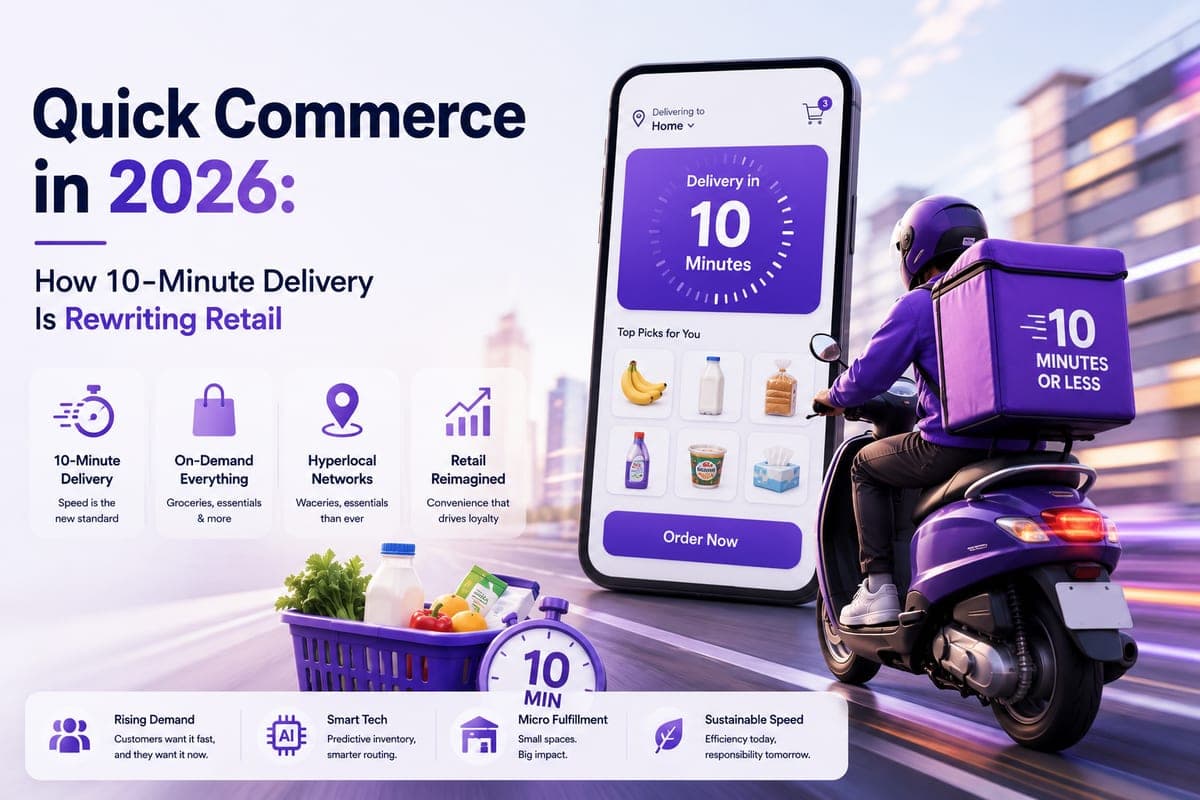
Five years ago, the idea that milk, headphones, or paracetamol would arrive at your door in under ten minutes sounded absurd. In 2026, it is so normal in Indian metros that anything slower feels broken. Quick commerce, or q-commerce, has gone from venture-funded experiment to a structural force inside the retail industry, and its ripples are now reaching D2C brands, FMCG giants, kirana stores, and global platforms alike.
This article unpacks what quick commerce actually is, how the unit economics work, who is winning the category in India and globally, what it means for traditional ecommerce and physical retail, and what brands need to do operationally to survive on these platforms. If you sell consumer products, the q-commerce question is no longer "should we be on it?" It is "what does our supply chain need to look like to win there?"
What Is Quick Commerce?
Quick commerce is the on-demand delivery of consumer goods, typically groceries, beauty, electronics, pharmaceuticals, and household essentials, within 10 to 30 minutes of order placement. It sits between traditional ecommerce (1 to 3 day delivery) and food delivery (30 to 45 minute hot meals).
The model rests on three pillars:
- Dark stores or micro-fulfillment centers placed densely within urban neighborhoods, each carrying 2,000 to 4,000 high-velocity SKUs
- A rider fleet dispatched on the shortest possible route, usually within a 2 to 3 km radius
- A software layer that compresses ordering, picking, packing, dispatch, and tracking into a single orchestrated workflow
Where conventional ecommerce optimizes for catalog breadth and cost, quick commerce optimizes for speed and convenience. The trade-off is intentional: fewer SKUs, narrower geography, higher cost per order, but unmatched delivery times.
The Origin of Quick Commerce
The category was effectively born around 2020 in Berlin and Istanbul with Gorillas and Getir, then exploded in India in 2021 when Blinkit (formerly Grofers), Zepto, and Swiggy Instamart pushed the median grocery delivery time below 15 minutes. According to data from Statista, the global quick commerce market reached roughly $25 billion in 2024 and is projected to keep growing through 2030, with India and parts of the Middle East emerging as the fastest-scaling regions.
India is now arguably the world's most mature q-commerce market. Dense urban populations, low rider labour costs, and a consumer base trained by years of food delivery created the perfect conditions. By the end of 2024, multiple Indian metros had quick commerce penetration above 30% of urban grocery orders.
How Quick Commerce Actually Works: The Operational Stack
The illusion of a 10-minute order hides a brutally precise operations chain. From the moment a customer taps "Place Order," roughly 8 minutes of real work happens:
- Seconds 0 to 10: Order routed to the nearest dark store with stock confirmed in real time
- Minutes 0 to 3: Picker collects items from a meticulously mapped shelf layout
- Minutes 3 to 4: Quality check, packing, label
- Minutes 4 to 10: Rider dispatched, navigated to the customer
For this to work, every system, inventory, order management, routing, dispatch, has to operate as one. There is no time for a sync lag. A platform whose stock count is wrong by even one unit triggers a cancellation, an angry customer, and a hit to the dark store's KPIs. This is why real-time inventory sync and intelligent order routing are non-negotiable infrastructure inside any q-commerce operation.
The Dark Store: The Hidden Backbone
Dark stores are the most misunderstood part of quick commerce. They are not "small warehouses." They are precision retail environments designed for picking speed, not browsing. A typical Indian dark store is 2,000 to 4,000 sq ft, carries 2,000 to 4,000 SKUs, and serves a 2 to 3 km radius with 1,500 to 3,000 daily orders.
Key design principles:
- Heat-mapped shelving: Fast-movers within arm's reach of the picker's start point
- Vertical density: Bins stacked high to maximize SKU count in a small footprint
- Strict no-customer policy: No retail floor distractions, no theft surface
- Cold chain zones: Refrigerated and frozen sections engineered for sub-30-second pick times
The economics of a dark store flip from loss-making to profitable around 1,200 to 1,500 orders per day, depending on average order value. This is why platform expansion is so cautious, adding a dark store is a six-month bet on neighborhood demand.
The Unit Economics of Quick Commerce
Quick commerce is famously hard to make profitable. Here is a simplified breakdown of where the money goes on a typical $5 (₹400) Indian grocery order:
- Cost of goods: ~75 to 80%
- Last-mile delivery (rider cost): 8 to 12%
- Dark store operating costs: 5 to 8%
- Customer acquisition (amortized): 2 to 5%
- Packaging, tech, support: 2 to 4%
This leaves contribution margins thin, sometimes negative on small baskets. The path to profitability runs through three levers: higher average order value, denser order clustering per rider trip, and private-label or high-margin SKUs (beauty, electronics, pharma) added to the mix.
By late 2024, Indian platforms had reportedly pushed several mature dark stores to genuine profitability, not just contribution margin, but full P&L profitability, proving the model can work at maturity. Analysis from Bain & Company and other consultancies has consistently flagged India as the cleanest path to profitable q-commerce globally, largely because of unit cost structure.
Quick Commerce in India: The Players and the Stakes
India's quick commerce market in 2026 is shaped by four large players and a long tail of category-specific entrants:
- Blinkit (Zomato): The market leader by GMV in most metros
- Zepto: The pure-play challenger, aggressively scaling dark store count
- Swiggy Instamart: Leveraging Swiggy's food-delivery rider network
- BBnow (BigBasket): Backed by Tata, with deep grocery roots
Beyond these, niche q-commerce in pharma (Tata 1mg, PharmEasy delivery), beauty (Nykaa Now), and electronics has emerged. Even Amazon and Flipkart, the giants of conventional ecommerce, have launched fast-delivery tiers to defend their share.
The competitive intensity is brutal. New consumers cost ₹400 to 600 to acquire, retention is fragile, and price wars on staple SKUs (atta, oil, milk) compress margins. Yet the category keeps growing because consumer behaviour has shifted permanently. The Reserve Bank of India consumer payment data shows quick commerce now accounting for a measurable share of urban digital spend, a share that did not exist three years ago.
What Quick Commerce Means for D2C Brands and FMCG
If you are a brand selling consumer goods, q-commerce changes three things.
One: distribution. Getting listed on Blinkit, Zepto, or Instamart is now as strategic as getting shelf space in DMart or Reliance Smart. Some categories, premium snacks, beverages, sexual wellness, pet food, have built entire brands almost exclusively through q-commerce.
Two: SKU strategy. Quick commerce favors smaller pack sizes (single-serve, trial packs) because basket size and storage density both improve. Brands that ship in 1kg packs may need to launch 200g variants to perform on these platforms.
Three: operations. You now need to feed a network of dark stores with consistent stock, manage demand spikes, and handle returns and unsold inventory faster. Brands that operate across q-commerce, marketplaces, their own D2C site, and physical retail need a unified system that treats every channel as a first-class location. This is exactly the problem multichannel order management solves, you cannot win on q-commerce while losing on Shopify or Amazon.
Quick Commerce vs. Traditional Ecommerce
The two models are converging operationally but remain distinct on customer expectations.
| Dimension | Quick Commerce | Traditional Ecommerce |
|---|---|---|
| Delivery time | 10 to 30 min | 1 to 3 days |
| SKU count per fulfillment node | 2,000 to 4,000 | 50,000 to millions |
| Order frequency per customer | 8 to 15/month | 2 to 4/month |
| Average basket size | Smaller | Larger |
| Cost per order | High | Lower |
| Returns rate | Low (~1 to 2%) | High (5 to 25%) |
Traditional ecommerce will not disappear. Apparel, big-ticket electronics, furniture, and long-tail categories still belong there. But for everyday consumption, the gravitational pull of 10-minute delivery is hard to escape.
The Supply Chain Behind 10-Minute Delivery
Behind every q-commerce order is a supply chain that looks nothing like traditional retail. It is hyper-distributed, software-orchestrated, and inventory-light at every node.
The chain works in three layers:
- Mother warehouses or distribution centers at the city periphery
- Dark stores in neighborhoods, replenished daily or twice-daily
- The rider network, dispatched in real time
What makes it work is the data layer running underneath. Each dark store needs to know its stock to the unit, predict the next two hours of demand, trigger replenishment when SKUs cross threshold, and reroute orders when an item is out. Without that, the model collapses into cancellations. Research from McKinsey on retail supply chain transformation has highlighted micro-fulfillment and real-time inventory as the two technologies most directly responsible for q-commerce viability.
For brands feeding into this system, the Nventory product feeds module and dropshipping/supplier automation let you push catalog and stock data to multiple platforms in the formats they require, without manual file uploads.
Quick Commerce Beyond Groceries
The category started with groceries because they are repeat-purchase, predictable, and the basket is built quickly. But the model is expanding fast:
- Pharmacy: Fastest-growing q-commerce sub-category in India after groceries
- Beauty and personal care: High margin, perfect basket sizes
- Consumer electronics: Phone chargers, earbuds, batteries, small, urgent, profitable
- Stationery and gifting: Birthday-card-at-the-last-minute use case is real and growing
- Pet supplies: A category quietly building loyal q-commerce buyers
- Fashion essentials: Innerwear, basics, accessories
The economic pattern is similar across categories: high frequency or high urgency wins. Niche categories with neither (e.g., furniture, formal apparel) will stay on conventional ecommerce.
What Could Slow Quick Commerce Down
Three risks are worth tracking.
Regulation. Multiple Indian states have raised concerns about dark stores operating as retail outlets without retail licenses. Pricing pressure on small kirana stores has triggered political pushback. Labour rules for delivery riders are tightening.
Profitability discipline. Public market scrutiny on cash-burning growth stories has intensified. Platforms cannot indefinitely subsidize ₹99 delivery thresholds.
Customer fatigue with "everything urgent." Some research suggests a ceiling exists, not every purchase needs to arrive in 10 minutes, and category fragmentation across multiple q-commerce apps is starting to annoy users.
None of these kills the category. But they will reshape it, likely toward consolidation, slightly slower delivery promises (15 to 20 minutes) at lower cost, and tiered pricing that monetizes speed itself.
What Brands Should Do in 2026
If you sell consumer products in India or any market where q-commerce is taking hold, do these things this quarter:
- Audit your presence on quick commerce platforms. Are you listed on Blinkit, Zepto, Instamart, BBnow? At what price? With which pack sizes?
- Build a q-commerce SKU strategy. Smaller packs, impulse-friendly bundles, premium variants.
- Get your stock data sync watertight. Q-commerce platforms penalize cancellations harshly. Real-time inventory accuracy is the entry ticket.
- Track q-commerce as its own channel. Not a sub-set of "ecommerce." It has its own economics, customer behaviour, and growth curve.
- Plan your fulfillment operations across all channels in one place. D2C, marketplaces, q-commerce, retail, a single source of truth is what keeps the wheels on. Tools like Nventory's multichannel platform are built for exactly this.
Final Word
Quick commerce is not a fad. It is a structural reorganization of how dense urban populations buy everyday goods, and the operational lessons it has produced, micro-fulfillment, real-time inventory, intelligent routing, are now being absorbed back into traditional retail and ecommerce.
For brands, the question is no longer whether to take the channel seriously. It is whether your back-end can keep up with a world where stockouts get noticed in seconds and overselling costs you visibility.
If you sell across q-commerce, marketplaces, and your own D2C site, see how Nventory unifies multichannel operations, supports 30+ channels, or start free to put your stock on one source of truth.
Frequently Asked Questions
Ecommerce is the broader category of buying goods online with delivery times typically of 1 to 7 days. Quick commerce is a specific sub-category focused on delivery within 10 to 30 minutes, achieved through neighborhood dark stores rather than central warehouses.
At the platform level, profitability is still a work in progress, but several Indian dark stores have reportedly reached full P&L profitability by 2024. Mature units, high average order values, dense order clustering, and private label SKUs are the levers that close the gap.
Three reasons: high urban density (which makes dark stores viable), affordable rider labor, and consumer behaviour already trained by food delivery. Together they create the cleanest unit economics for q-commerce globally.
A dark store is a small, closed-to-public retail-style fulfillment center in an urban neighborhood, designed for pickers (not shoppers) to fulfill online orders within minutes. They typically carry 2,000 to 4,000 high-velocity SKUs.
Not entirely. Kirana stores have advantages quick commerce cannot match: credit relationships, deep local knowledge, very small basket convenience, and trust. But they will lose share in dense urban neighborhoods unless they digitize.
Related Articles
View all
PO Systems for Small Business: What They Do and How to Choose One
How purchase order systems work, when a small business actually needs one, the four types available, and a checklist for choosing between them.
Best Inventory Management Software in India in 2026: Matched by Business Model
Best inventory management software in India, matched by business model, honest pricing, and what top Indian ecommerce operators actually run in 2026.